AI Voice Agent and Chat Platform
TanvirSoftCall
AI Voice Platform, Contact Center and Multi Tenant PBX
Project URL
Overview
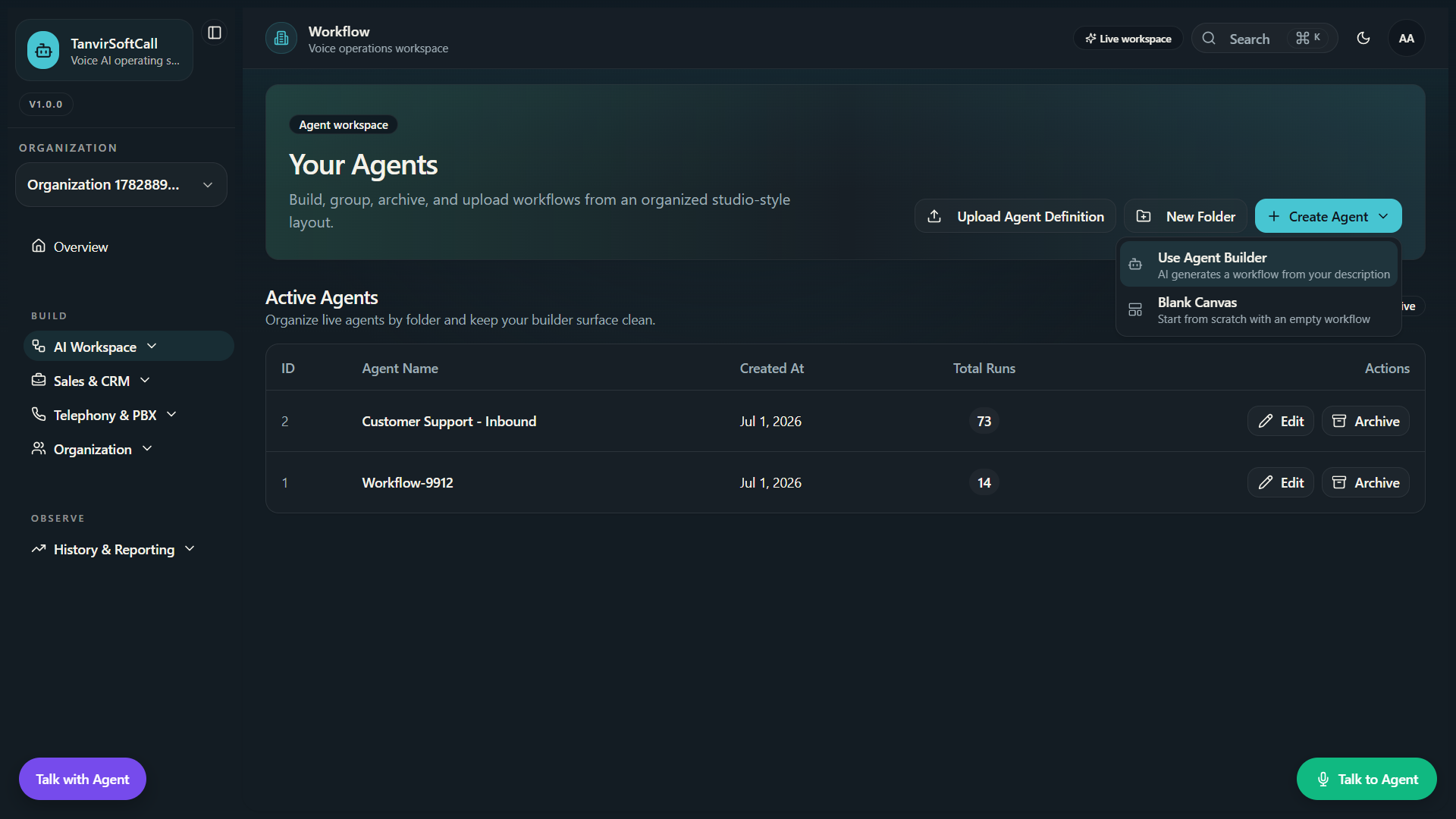
TanvirSoftCall is a self hosted multi tenant communication platform that combines AI voice agents, browser calling, SIP telephony, CRM, workflow automation and contact center operations in a single application.
The platform allows organizations to deploy AI powered voice agents, manage PBX resources, operate browser based calling, integrate website voice and chat widgets and monitor customer communication from one centralized dashboard. Each organization operates in an isolated tenant environment with dedicated telephony resources, AI workflows and business data.
The system is designed for businesses that need an intelligent communication platform capable of supporting customer service, sales, appointment booking, lead qualification and internal telephony without relying on multiple disconnected products.
Business Challenge
Modern businesses often depend on separate platforms for PBX management, AI voice agents, browser calling, CRM, campaign automation and customer messaging.
Maintaining multiple systems increases operational complexity, creates fragmented customer data and makes it difficult to automate business workflows.
TanvirSoftCall addresses this challenge by bringing AI communication, telephony infrastructure and customer operations together into a single platform with centralized management and complete tenant isolation.
Key Features
AI Voice Platform
- Visual workflow builder for AI voice agents
- Configurable LLM, Speech to Text and Text to Speech providers
- Real time speech to speech conversations
- Prompt management and reusable workflow templates
- Knowledge base with Retrieval Augmented Generation
- Document processing and vector search
- Browser based agent simulator
- Call recording and transcript management
Communication Platform
- Browser based voice calling using WebRTC
- Website voice widget
- Website AI chat widget
- Chat history and conversation analytics
- Call history with recordings and transcripts
- Token usage monitoring
PBX Management
- Multi tenant Asterisk PBX management
- SIP extension management
- Trunks and DID configuration
- IVR management
- Call routing
- Queue management
- Voicemail
- Extension to extension calling
- AI agent call routing
- PBX monitoring and health checks
Contact Center
- Agent workspace
- Live call monitoring
- Agent presence
- Queue management
- Campaign management
- Contact management
- Lead management
- Company management
- Activity tracking
- Notes and task management
Multi Tenant SaaS
- Organization management
- User management
- Role based permissions
- Tenant isolation
- Usage tracking
- Billing foundation
- API key management
- SDK support
- Audit logs
- System administration
My Contributions
- Designed the complete software architecture for both the SaaS application and PBX service
- Developed the FastAPI backend using asynchronous architecture
- Designed the PostgreSQL database with complete tenant isolation
- Built the Next.js administration portal and visual workflow builder
- Integrated AI voice pipelines using configurable LLM, Speech to Text and Text to Speech providers
- Developed WebRTC browser calling with WebSocket signaling
- Built secure website voice and AI chat widgets
- Implemented self hosted STUN and TURN infrastructure for reliable WebRTC connectivity
- Integrated Asterisk through ARI and AMI for SIP provisioning and intelligent call routing
- Developed PBX synchronization services with automatic configuration management
- Built CRM, campaign management, reporting and product management modules
- Implemented asynchronous background processing using Redis and ARQ
- Containerized the entire platform using Docker Compose
- Configured production infrastructure with Nginx, PostgreSQL, Redis, MinIO, coturn and Asterisk
- Added automated testing, health monitoring and deployment documentation
Technical Architecture
The platform consists of two independent services that communicate through authenticated internal APIs.
The main application is responsible for authentication, organization management, AI workflows, CRM, browser calling, reporting and business operations.
A dedicated PBX service manages Asterisk communication, SIP configuration, telephony events and runtime synchronization.
PostgreSQL stores application data while Redis and ARQ process background tasks. MinIO manages recordings and media assets. WebRTC provides browser communication and Asterisk handles SIP signaling and RTP media. Docker and Nginx provide production deployment and secure networking.
Technologies
Frontend
- Next.js
- React
- TypeScript
- Tailwind CSS
- React Flow
- Zustand
- Recharts
Backend
- Python
- FastAPI
- SQLAlchemy
- Alembic
- Pydantic
Artificial Intelligence
- Pipecat
- OpenAI Compatible Models
- Speech to Text Providers
- Text to Speech Providers
- Retrieval Augmented Generation
- Vector Search
Communication
- WebRTC
- WebSocket
- STUN
- TURN
- coturn
PBX
- Asterisk 22
- PJSIP
- ARI
- AMI
- SIP
- RTP
Database
- PostgreSQL
- pgvector
- Redis
Infrastructure
- Docker
- Docker Compose
- Linux
- Nginx
- MinIO
- Let's Encrypt
Engineering Challenges
- Designed a scalable multi tenant architecture with complete data isolation
- Synchronized live PBX configuration with application state
- Built reliable WebRTC connectivity across NAT, WiFi and mobile networks
- Connected AI voice pipelines with Asterisk using ARI and external media channels
- Managed asynchronous processing for recordings, AI workflows and PBX synchronization
- Unified browser calls, AI conversations and SIP calls into a single communication history
- Implemented secure tenant aware provisioning without service interruption
Outcome
TanvirSoftCall delivers a complete communication platform that combines conversational AI, browser based calling, PBX management and customer engagement into a single multi tenant application.
The project demonstrates expertise in backend engineering, real time communication, AI integration, SaaS architecture, cloud infrastructure and production deployment. It reflects the ability to design and build complex enterprise software that integrates modern AI capabilities with traditional telephony and business operations.